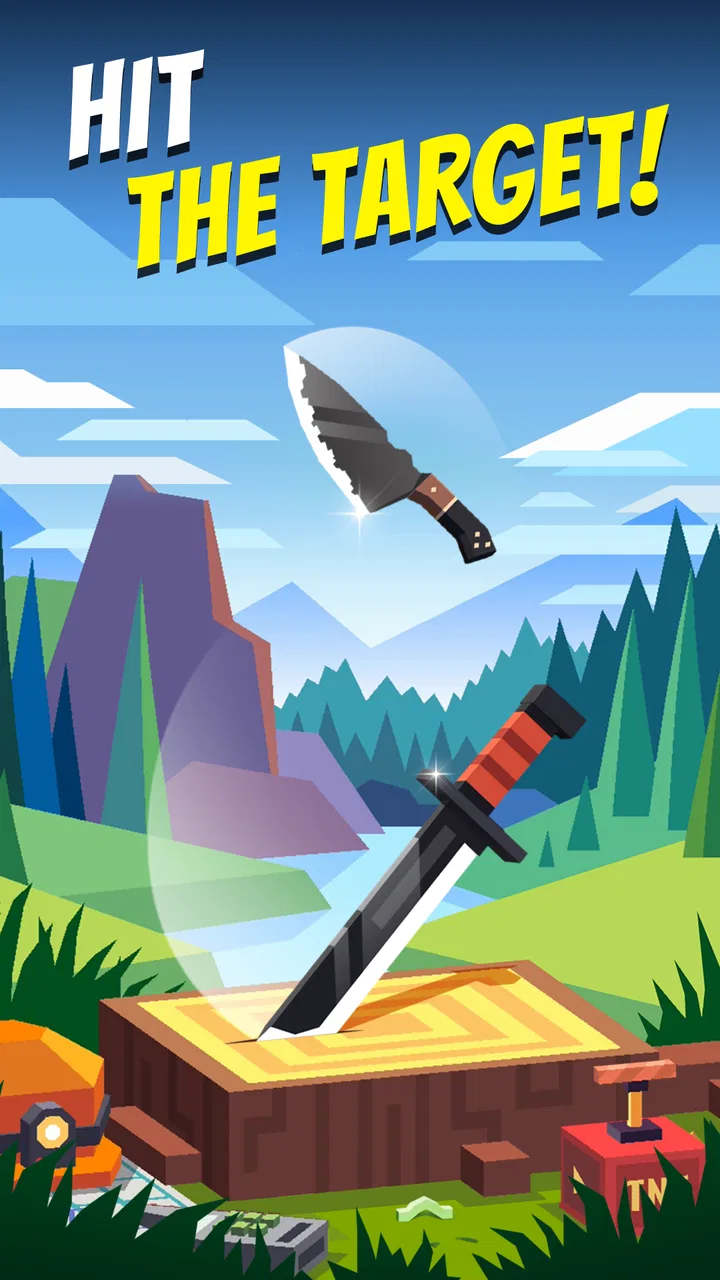
Flippy Knife: 3D flipping game
- 4.3
- Rating
- 10.00M
- Installs
- Free
- Price

 Analysis by App-foxy
I picked up Flippy Knife expecting a quick arcade distraction, and that is exactly how it first feels: immediate, simple, and surprisingly easy to play for a few minutes at a time. The basic idea is to throw and spin a knife, then land it on a target, but the timing becomes much less forgiving once the game starts asking for accuracy rather than luck. That small change gives the opening sessions a pleasant “one more try” pull.
This is a free arcade game from Beresnev Games, available to players rated Everyone. It has been around since August 3, 2017, and its current version is 2.3.10, so it is not a brand-new experiment looking for an audience. The large player base also makes sense to me: the controls are easy to understand without a tutorial-heavy introduction, and a short attempt does not demand the commitment of a full puzzle, racing, or action game.
After spending time with it, my main question was not whether the flipping is enjoyable. It is. The more useful question is whether that enjoyment survives after the novelty of landing a few satisfying throws wears off. My answer is mixed but positive: it earns a place as a compact time-killer, though it is less convincing as a game I would play continuously for long sessions.
You May Also Like

 Blood Strike: 2.5 Anniversary
Blood Strike’s Loadouts Turn Every Drop Into a Tactical Gamble
A close look at Blood Strike’s custom loadouts: how fast access to signature weapons reshapes its battle royale rhythm, rewards preparation, and narrows the gap between fights.

 Pandora - Music & Podcasts
Pandora’s Music Is Easy to Start, but Harder to Recover
Pandora’s strength is its low-effort path from a seed to a station. Its weak spot is how much confidence it asks you to place in connection, setup, and quiet recovery.

 8 Ball Pool
 Is Built on Rivalries, Rematches, and Routine
A close look at the rivalries, rematches, shared routines, and unanswered safety questions that turn a quick pool match into a persistent mobile community.

 Samsung Music
’s Quiet Strength Is Playing What You Already Own
Its reach comes less from spectacle than from dependable access to a personal library. That simplicity is both the app’s strongest retention engine and its ceiling.

 AccuWeather: Weather Radar
AccuWeather Review: A Quick, Clear Forecast for Everyday Decisions
For everyday plans, the best forecast is the one you can understand quickly. AccuWeather makes rain timing, radar, and local conditions easy to act on, with a few trade-offs.

 Hill Climb Racing
Why Hill Climb Racing Still Turns Crashes Into One More Run
A tiny car, a bumpy hill and one more upgrade: Hill Climb Racing keeps resurfacing because its simple chaos makes every near-miss feel personal.
More From Our News Desk



Why the first week feels so inviting
The strongest part of the experience is the low barrier to entry. I can open it, understand the objective almost immediately, and start making attempts without arranging a long play session. That makes it particularly suitable for a commute, a short break, or those moments when I want something interactive but do not want to follow a story or remember a complicated control scheme.
The physical rhythm is what gives the game its character. A throw is not just a tap followed by a result; I am watching the knife rotate and trying to judge when the landing will line up. Early success feels tactile even though the action is entirely on screen. When I miss, the failure is usually readable enough that I want to adjust the next attempt rather than blame the game instantly.
That immediacy is more important than it sounds. Many arcade games are technically simple but take too long to become interesting. Here, the central action is visible from the start. I do not need to learn a collection of systems before finding out whether the game suits me. If you enjoy timing-based challenges and repeated attempts, the first week is likely to be the most naturally exciting period.
I also found that the game works best when I treat each attempt as a small experiment. Instead of rushing through throws, I pay attention to the rhythm of the rotation and the point at which I release. This is one of the more useful habits to develop early: consistency matters more than frantic tapping. A player who slows down slightly can often get more from the same control than someone who simply repeats attempts at full speed.
It is worth setting expectations about the kind of fun involved. This is not a deep arcade adventure with a large narrative arc, and it is not trying to replace a full competitive game. Its appeal comes from repetition, timing, and the satisfaction of improving a small physical action. If you want a game that can be understood in seconds and revisited without preparation, that simplicity is a strength. If you need constant novelty, it may already feel narrow after the first few sessions.
The game is free to start, which makes trying it straightforward. It includes optional in-app purchases ranging from $0.99 to $59.99 per item, so I would approach the store elements with a little discipline. The core appeal is the throwing challenge, not the assumption that spending will make the experience more rewarding. I recommend playing long enough to decide whether the basic loop holds your attention before considering any purchase.
Small habits that make the controls feel better
My most practical tip is to avoid judging a failed throw only by its outcome. Watch the rotation and ask whether the release was early, late, or simply too forceful. That turns a miss into information. It also prevents the common arcade-game trap of changing several things at once, which makes it difficult to know what actually improved the result.
A second useful approach is to use short practice bursts instead of trying to force a long winning streak. I get better feedback from several focused attempts, followed by a break, than from playing while irritated. The game’s short-session design supports this naturally. It is easy to close it after a few minutes and return later without feeling that I have abandoned a major campaign.
Finally, I would not play with the expectation that every attempt should feel equally controlled. Part of the appeal is reacting to the result and trying again. When I accept a little variability, the game feels playful. When I demand perfect predictability from every throw, the same loop becomes much more tiring.
What remains after the first month
The long-term value depends heavily on what you want from an arcade game. For me, the game remains useful as a pocket-sized reset between more demanding tasks. I can play it while waiting for an appointment or during a short pause at home, then put it away without needing to remember a complicated objective. That recurring convenience is more durable than the initial surprise.
Its month-to-month appeal comes from personal improvement rather than a broad stream of new ideas. I return when I want to sharpen timing, chase a better run, or simply occupy my hands. That is a legitimate form of replay value, but it is also a limited one. Players who need fresh environments, evolving stories, or a large variety of mechanics may find that the central knife-flipping action does not provide enough change on its own.
The game is best compared with other quick arcade and reflex titles, not with substantial action games. Against a more elaborate alternative, it wins on speed and accessibility. I can begin playing almost instantly, and the controls do not create a long learning curve. Against an arcade game built around constantly changing challenges, however, it may lose because the basic action remains the main reason to return.
That comparison helped me understand who will keep it installed. If your phone already has several large games and you want one compact option for idle moments, this can fill that role well. If you are looking for a single game to occupy an entire evening every day, I would choose something with more varied progression. The difference is not quality so much as the kind of attention each game asks for.
There is also a useful distinction between occasional habit and daily routine. As an occasional habit, the game holds up because it is easy to start and stop. As a daily routine, its repetition becomes more noticeable. I can imagine returning regularly for a while, then leaving it untouched until I want a simple timing challenge again. That pattern feels more realistic than expecting it to become a permanent main game.
The audience size supports the idea that the formula has broad reach. It has passed 10 million installs, with an average rating of 4.3 from around 858 thousand ratings and about 61 thousand written reviews. Those figures do not guarantee that every player will enjoy the same loop, but they do reflect a game that has remained visible well beyond its launch period.
Who gets the most value from it
I would recommend it to someone who enjoys precision, retrying a move after a mistake, and playing in compact bursts. It is also a good fit for a younger or mixed-age household because the content rating is Everyone and the basic premise is easy to explain. A parent looking for a simple game that can be understood quickly may find it more approachable than a complex strategy or multiplayer title.
It is less suitable for someone who dislikes repetition or becomes frustrated when progress depends on small timing adjustments. Players who prefer exploration, character development, or a strong sense of long-term progression should probably look elsewhere. The same minimalism that makes the game welcoming can make it feel thin if you want a constantly expanding experience.
One realistic use case is a short work break. I might play several attempts, notice that my timing is getting worse because I am rushing, and stop before the game turns into a source of irritation. That is a better way to use it than opening it with the intention of filling an entire hour. Its value comes from fitting around life, not demanding that life revolve around it.
Maintenance, friction, and the reasons fatigue appears
The maintenance burden is fairly light from a player’s point of view because the game does not require a large time investment to remain familiar. I do not need to relearn a complicated system after a break. Returning after several days feels natural: I can make a few throws, recover the timing, and decide whether I want to continue.
That low commitment is one of its best qualities, but it also exposes the main weakness. There is only so much variety a player can draw from repeating the same central action. Once the basic motion becomes familiar, the excitement depends on personal goals and tolerance for retrying. Without that internal motivation, the game can start to feel like a test of patience rather than a source of entertainment.
Another source of friction is the temptation to chase a result after a frustrating miss. I have found that this is when the experience deteriorates fastest. The more annoyed I become, the less carefully I read the timing, and the more attempts blur together. A simple rule helps: if I make several rushed throws in a row, I stop for a few minutes. That keeps the game in the “quick break” category instead of turning it into an unwanted argument with my phone.
The purchase range is another reason to pay attention to your own habits. Because the game is free, it is easy to try without financial commitment, but optional items priced from $0.99 up to $59.99 can make the surrounding economy feel more significant than the core action requires. I would not recommend buying anything simply because a difficult sequence is testing my patience. First decide whether the unmodified loop is enjoyable enough to justify spending at all.
Device compatibility is reasonably broad: the listed minimum operating system is Android 7.0. That helps explain why it can serve as a practical casual game rather than one reserved for newer phones. Still, the experience will depend on the device and the way it handles touch input. For a timing game, a responsive screen matters more to me than impressive graphics, so I would pay attention to whether the controls feel consistent on the phone I actually use.
The age rating also makes it easier to recommend in general terms, but adults should not mistake accessible content for unlimited depth. Everyone can understand the premise; not everyone will want to repeat it for months. The right expectation is a friendly arcade challenge with recurring short-session value, not a complete entertainment ecosystem.
How I would keep it enjoyable over time
I would rotate it with other games instead of making it the only title on my phone. That simple maintenance choice protects its strongest quality: freshness during short visits. When I return after playing something else, the act of controlling the knife feels more distinct. When I play continuously for too long, I notice the narrowness of the loop much sooner.
I would also create personal limits rather than relying on the game to provide endless motivation. A short session focused on cleaner throws is more satisfying than an open-ended attempt to keep playing until boredom arrives. This is especially useful for people who install games during a stressful day and then find themselves using them to avoid taking a proper break.
My third recommendation is to separate improvement from spending. If a purchase is available, it should support an experience I already enjoy, not serve as a solution to impatience. The game is most convincing when the satisfaction comes from learning the timing. Preserving that relationship makes the free entry point feel meaningful rather than merely promotional.
My long-term verdict
Flippy Knife earns lasting space as a compact arcade companion, not as a forever main game. I like that it respects short sessions, communicates its central challenge quickly, and gives each attempt a clear physical objective. Beresnev Games has built something that is easy to recommend to a friend who wants a simple reflex game without a long explanation.
Its lasting value is conditional. I would keep it installed if I wanted a quick timing challenge for waiting rooms, breaks, or brief moments when more involved games feel excessive. I would remove it if I found myself repeating attempts without learning anything new, or if I wanted stronger progression and broader variety from my regular game.
The game’s history since 2017, its free entry point, and its current version 2.3.10 make it feel like an established casual option rather than a temporary novelty. Yet longevity should not be confused with endless depth. The best way to appreciate it is to use it in the role it handles well: a small, accessible arcade diversion that rewards attention in short bursts.
If you enjoy the satisfaction of correcting a tiny mistake and trying again, I think you will understand its appeal quickly. If repetition normally wears you down, the first-week excitement may be as far as the relationship goes. My recommendation is therefore straightforward: try it for the core flipping challenge, keep your sessions measured, and judge its place on your phone by whether it still feels refreshing after the first rush has passed.
FAQs for Flippy Knife: 3D flipping game
01What is the main objective of Flippy Knife?
Flippy Knife is a 3D flipping game where players aim to master the art of knife flipping. The main objective is to flip various types of knives, axes, and swords to land them perfectly on designated surfaces. Each successful flip earns points, and players can unlock new levels and blades as they improve their skills.
02Is Flippy Knife free to play on Android and iOS?
Yes, Flippy Knife is free to download and play on both Android and iOS devices. However, it contains optional in-app purchases that allow players to buy coins or unlock certain features more quickly. These purchases are not necessary to enjoy the full experience of the game.
03What are the system requirements for Flippy Knife?
Flippy Knife is designed to run smoothly on most modern smartphones and tablets. For Android users, it requires Android version 4.4 or higher. iOS users need to have iOS 9.0 or later. A stable internet connection is recommended for accessing all game features and updates.
04Does Flippy Knife offer multiplayer or online modes?
Flippy Knife is primarily a single-player game focused on improving personal skills and achieving high scores. However, it features leaderboards where players can compare their scores with friends and other players globally, adding a competitive edge to the experience.
05Are there any tips for beginners in Flippy Knife?
For beginners, it’s important to start with the basic knives to understand the mechanics of flipping. Practice consistently to improve accuracy. Keep an eye on the angle and force of the flip. As you progress, experiment with different blades, each with unique physics. Patience and practice are key to mastering the game.
Pros
- Engaging gameplay with simple controls.
- Variety of knives to unlock and use.
- Realistic physics for challenging fun.
- Offline mode available for play anywhere.
- Frequent updates with new features.
Cons
- Ads can be intrusive and frequent.
- In-app purchases can be pricey.
- Repetitive gameplay may bore some.
- Requires precision
- can be frustrating.
- Limited tutorial for beginners.

Flippy Knife: 3D flipping game
Gallery